Guadalupe-Reyes marathon: how much weight you gain and how to avoid it
From December 12 to January 6 there are lots of celebrations, but not 26 days of feasting. What studies say about holiday weight gain and what actually works to reach January in good shape.
The short version
- The marathon runs from December 12 (Our Lady of Guadalupe) to January 6 (Three Kings' Day), but the big feast days are only a handful.
- Studies that actually weigh people find an average gain of 0.4 to 0.9 kg over the holidays, according to a review from Mexico's University of Sonora. Not 8 kilos, but it can stick year after year.
- What has evidence behind it is keeping an eye on things: in a trial published in the BMJ, people who weighed themselves regularly and knew how much exercise equals their Christmas food didn't gain weight.
- The realistic goal for December is to maintain, not to diet. Save the deficit for January.
What the Guadalupe-Reyes marathon is
That's what Mexicans call the stretch from December 12, the feast of Our Lady of Guadalupe, to January 6, Three Kings' Day. In between come the posadas, Christmas Eve, Christmas Day, the recalentado (the day of leftovers), New Year's and the rosca de reyes: almost four weeks in which food and drink are part of the party.
But it isn't 26 days of feasting. The big days are only a handful; the rest are ordinary days that slowly fill up with leftovers, office snacks and candy from the aguinaldo bags. That's the difference between reaching January in good shape or not.
How much weight do people really gain?
Every December you hear that people gain several kilos over Guadalupe-Reyes, sometimes "up to 8." Studies that actually weigh people tell a different story. A review by researchers at Mexico's University of Sonora and CIAD, published in the Journal of Obesity in 2017, found that adults gain 0.4 to 0.9 kg (about 1 to 2 lb) on average over the holiday season.
That sounds small, but there's a catch: in the New England Journal of Medicine study that followed 195 adults after the holidays, that weight wasn't lost in the months that followed. If every December left half a kilo behind, ten years would add five. And it's an average: some people gain nothing and some gain quite a bit more.
The big days and the ordinary days
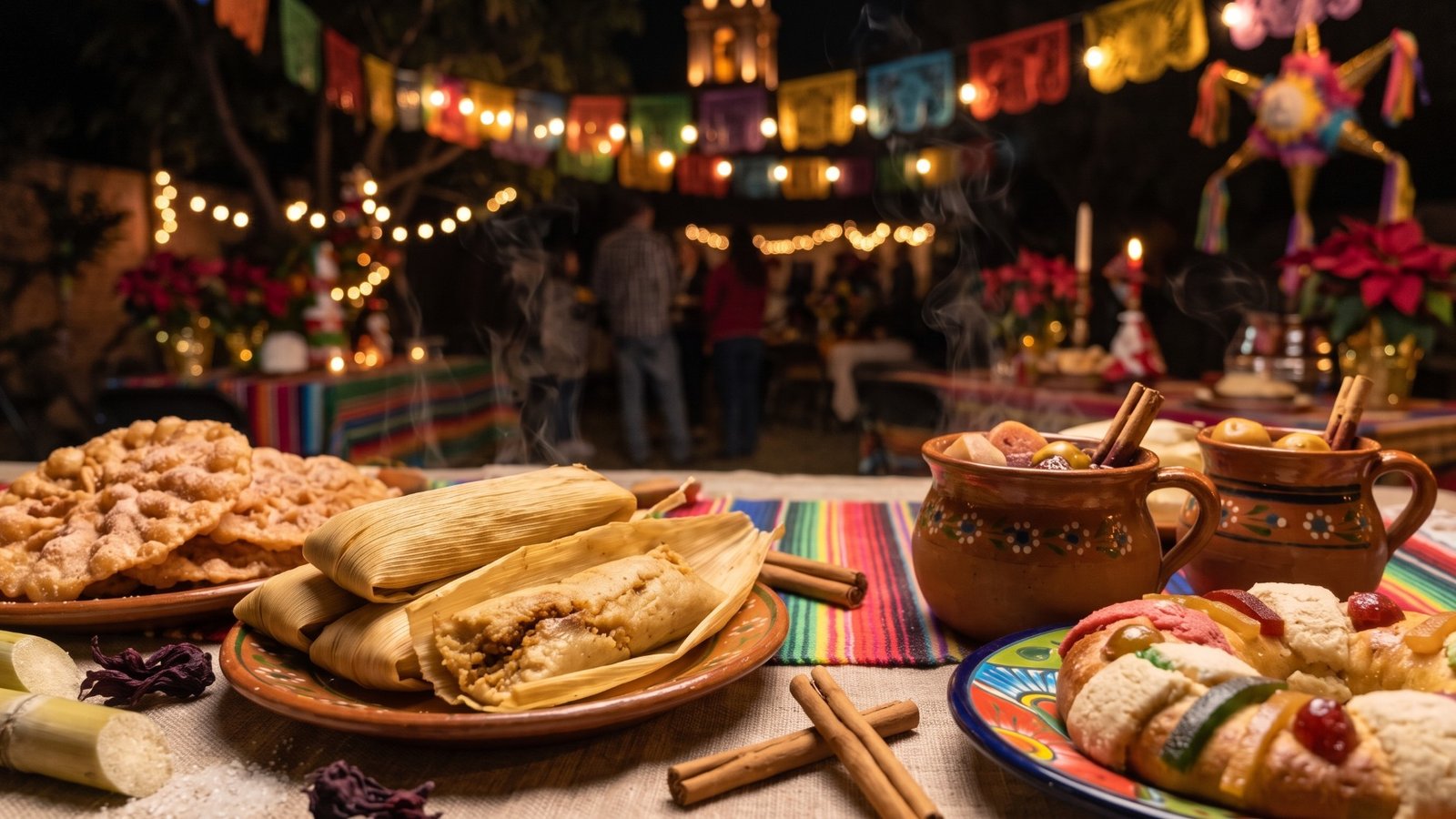
The big days of the marathon tend to be the 12th, your posadas, the 24th, the 25th with its recalentado, the 31st, the 1st and the 6th. Those days bring tamales and ponche, bacalao, romeritos, pork leg or turkey, toasts and rosca. We already covered how many calories are in tamales, ponche and buñuelos.
The ordinary days are the ones that slip: leftovers nibbled at odd hours, office snacks and pan dulce, candy from the aguinaldo. And alcohol, which has about 7 kcal per gram: a 30 ml drink of a 40% spirit is about 65 kcal, plus whatever soda or juice it's mixed with.
What actually works, according to studies
The good news is that keeping an eye on things works better than banning foods. In a clinical trial published in the BMJ in 2018, 272 adults in the United Kingdom were randomly given either a healthy-living leaflet or a brief intervention: regular self-weighing, weight-management tips and information on how much exercise equals common Christmas foods and drinks. Over the holidays, the leaflet group gained 0.37 kg on average; the intervention group didn't gain (−0.13 kg).
In another trial, published in Obesity in 2019, 111 adults in the United States weighed themselves daily on a scale that showed them their trend graph: they didn't gain weight over the holidays, while the control group did. And the University of Sonora review found that programs based on self-monitoring appeared to prevent weight gain, although the evidence is still limited.
Weighing yourself or logging what you eat isn't obsession: it's knowing where you stand. If it makes you anxious, or if you've had an eating disorder, talk to a professional first.
A simple plan for the marathon
- Mark your big days: put the 12th, your posadas, the 24th, the 31st and the 6th on the calendar. On those days, enjoy without guilt.
- Keep the other days ordinary: your usual breakfast, lunch and dinner. The recalentado is one meal, not three.
- In December, the goal is to maintain: don't try to lose weight in the middle of the holidays. Save the calorie deficit for January.
- Keep an eye on it: weigh yourself on the same scale at the same time of day, or log what you eat. Pick what works for you.
- Watch what you drink: alternate ponche and toasts with water. Liquids add up too, as we explain in the calories you drink.
- Move: a walk after dinner counts too.
 With CalorIA Scan
What CalorIA Scan does for you
- Log your big days in seconds: take a photo of your Christmas Eve plate or the recalentado and the app estimates calories and macros, built for real Mexican food.
- Adjust portions and ingredients: fix the portion (from ½ to 5) or remove and swap ingredients; everything recalculates instantly.
- See your whole season: history and streak show how you're doing, not just one night.
- Set your goal: define your calorie and macro targets based on your body, activity and goals. In December, that can be maintenance.
- Share it with your dietitian: generate a PDF report with your history, macros and calories.
CalorIA Scan doesn't prescribe a diet or replace a professional: it helps you know how much you eat so that you, and your dietitian if you want, can decide. Values are AI estimates.
The practical takeaway
Guadalupe-Reyes isn't the problem; the problem is when the little you gain each December stays. Enjoy your big days, keep the rest ordinary, keep an eye on your weight or what you eat, and save the deficit for January.
Stop guessing your calories
CalorIA Scan reads your plate from a photo and gives you calories and macros tuned for real Mexican and Latino food — where generic apps get it wrong.
Get CalorIA Scan freeSources
- Díaz-Zavala RG, et al. (University of Sonora, CIAD). Effect of the Holiday Season on Weight Gain: A Narrative Review. J Obes, 2017
- Mason F, et al. Effectiveness of a brief behavioural intervention to prevent weight gain over the Christmas holiday period: randomised controlled trial. BMJ, 2018
- Kaviani S, vanDellen M, Cooper JA. Daily Self-Weighing to Prevent Holiday-Associated Weight Gain in Adults. Obesity, 2019
- Yanovski JA, et al. A prospective study of holiday weight gain. N Engl J Med, 2000
- MedlinePlus — Alcohol and diet: about 7 calories per gram of alcohol
Post on Instagram
Copy the text, download the image, then open Instagram and paste it. Instagram does not allow clickable links in captions: add the article link as a link sticker on a Story, or keep it in your bio.
Keep reading
- 🫔HealthPosadas calories: tamales, ponche and buñuelos
- ⚖️HealthCalorie deficit: what it is, why it matters and how CalorIA Scan helps you track it
- ☕HealthThe calories you drink: what's in your glass that almost nobody counts
- 🧪AdditivesThat bright green in your chewing gum isn't "natural" — it's chlorophyll with copper
This article is informational and not medical advice. Consult a doctor or registered dietitian before changing your diet, especially with a pre-existing condition.
Comments