Posadas calories: tamales, ponche and buñuelos
A tamal, a guajolota, a cup of ponche: what each treat adds, why the numbers vary so much, and how to enjoy the season without losing count.
The short version
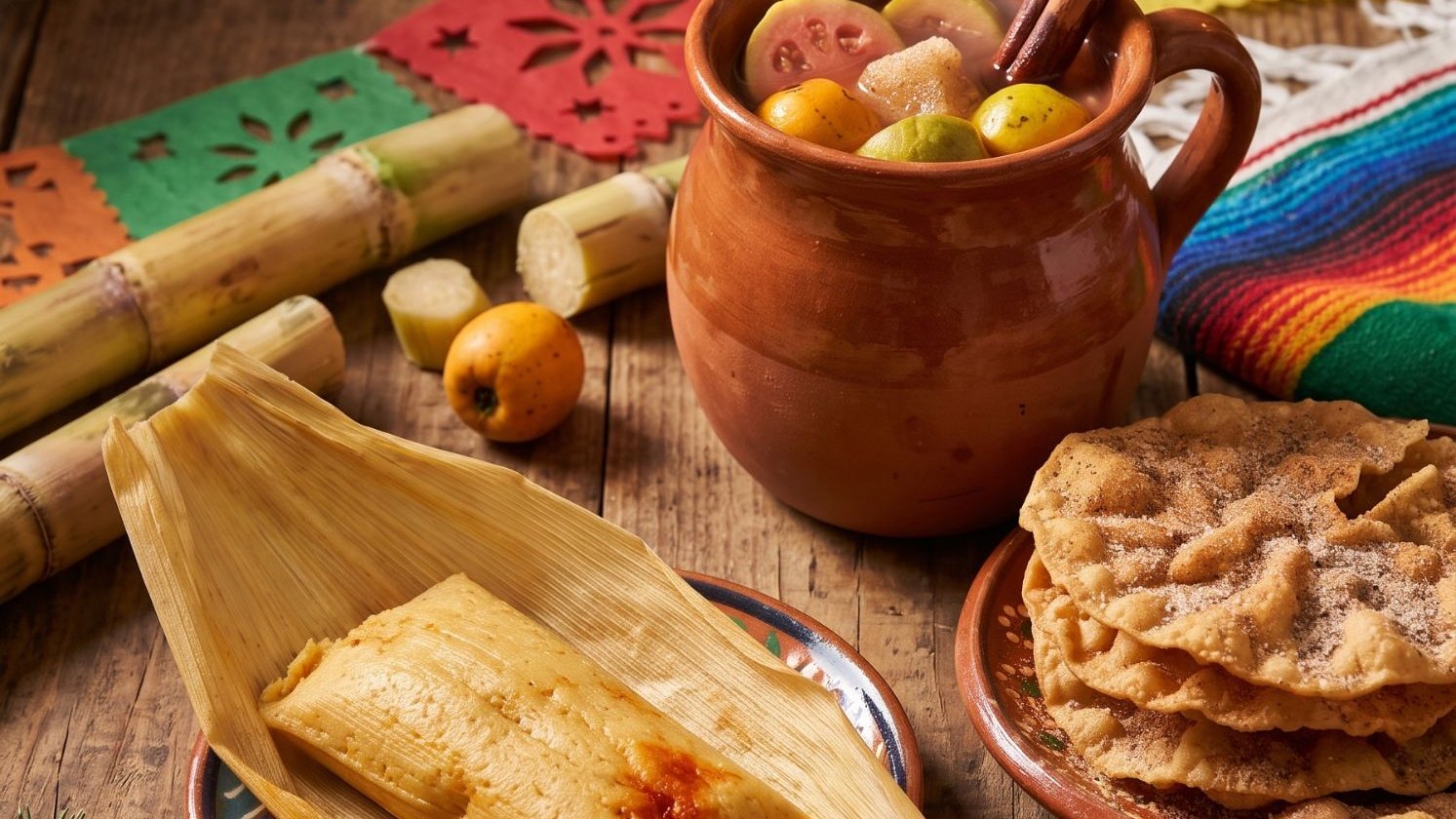
- A tamal has roughly 320 to 600 kcal, depending on its size, the lard and the filling. A guajolota (a tamal in a bread roll) is around 700.
- Fruit-only ponche has about 150 kcal a cup; with sugar or piloncillo it climbs to 250 or 300, according to a UNAM nutritionist.
- Combinations add up the most: a guajolota with a cup of milk-based atole is about 885 kcal in one snack.
- Nothing is off-limits: pick, share, measure your ponche and log what you eat so you see your whole week.
Why the posadas add up
From December 16 to 24, Mexico celebrates the posadas, nine nights of pre-Christmas parties that bring the season's favorite treats to one table: tamales, ponche (a hot fruit punch), buñuelos, atole and the aguinaldo bag of fruit and candy. None of them is a problem on its own. What adds up is the combination, repeated night after night between the family posada, the office one and the one with friends.
How much weight do people gain over the holidays? Less than you hear, but it stays. A study in the New England Journal of Medicine followed 195 adults in the United States: over the year-end holidays they gained 0.37 kg (about 0.8 lb) on average, and they didn't lose it in the months that followed. The authors note that the idea of everyone gaining several kilos has little support; the problem is that a little every December adds up.
Tamales: 320 to 600 kcal, depending on who makes them
There is no single number for a tamal, and even official sources disagree. For an average 200 g tamal, Profeco (Mexico's consumer protection agency) estimates about 515 kcal for a green or red one, 520 for rajas con queso (chile strips and cheese) and 365 for a bean one, according to figures reported by ADN40. The Mexican System of Food Equivalents (SMAE), cited by El Universal, gives 510 kcal for a meat tamal, 430 for a sweet corn one and 520 for rajas con queso. For the meat tamal, Profeco gives 352. And specialists at IMSS, Mexico's social security health system, cited by Infobae, put it at about 600 kcal per tamal.
In the CalorIA Scan database, a 200 g tamal colorado comes in at 320 kcal. Why such a spread? Three things: size (a small street-stall tamal is not an Oaxacan one wrapped in banana leaf), how much lard goes into the masa, and the filling. Cheese and fatty meats push the count up; bean tamales tend to sit lower.
For your tally: for many people, one tamal is already a full meal. If it's your dinner, it doesn't need bread.
Guajolota and atole: when the tamal comes with company
The torta de tamal, or guajolota, is the clearest example of how treats stack up. The SMAE, cited by El Universal, puts it at about 700 kcal and 32 g of fat. Add a cup of milk-based atole (240 ml), which the same source puts at about 185 kcal, and you reach about 885 kcal in a single snack.
Atole and champurrado vary a lot by recipe: water or milk, more or less sugar. We cover that in the calories you drink.
Ponche: the fruit isn't the problem, the piloncillo is
Ponche is made with guava, tejocote, apple, sugarcane, prunes and cinnamon. According to Mariana Isabel Valdés Moreno, head of the Nutrition program at UNAM's FES Zaragoza, a cup of fruit-only ponche has about 150 kcal on average; with sugar or piloncillo (unrefined cane sugar), it climbs to 250 or 300.
She explains that the sugarcane and fruit already sweeten it, and that ponche gets sweeter every time it boils, so there's no need to add more. Her advice: one or two cups a day, in moderation.
And the piquete, the splash of liquor? Alcohol has about 7 kcal per gram. A 30 ml (1 oz) splash of 40% brandy or rum carries about 9.5 g of alcohol: roughly 65 extra kcal per cup, on top of the sugar.
Buñuelos and the aguinaldo bag: fried and sweet
A buñuelo is fried dough, usually topped with sugar or piloncillo syrup: fat from the frying oil and sugar in the same piece. Sizes vary a lot from one stand to the next, so no single number fits them all; if you have one, log it at its real size.
In the aguinaldo bag, the fruit (mandarin, sugarcane, tejocote, jicama) is the lightest part. Candy adds sugar, and peanuts, nutritious as they are, pack a lot of calories into a small handful.
How to enjoy the posadas without losing count
- Pick one: a tamal or a guajolota, not both. If you want to try flavors, share: half a green one, half a rajas one.
- Ponche for the fruit: have one cup, not three; ask for it without extra piloncillo and eat the fruit.
- Watch the piquete: it adds alcohol calories on top of the sugar.
- Don't arrive starving: when you're very hungry, it's harder to choose calmly.
- Think about your week, not one night: one posada doesn't define your month. What counts is the balance over several days, as we explain in what a calorie deficit is.
- Log it without guilt: writing down what you ate isn't punishment, it's knowing where you stand.
 With CalorIA Scan
What CalorIA Scan does for you
- Scan your posada plate: take a photo of the tamal, the guajolota or the cup of ponche and the app estimates calories and macros, built for real Mexican food.
- Adjust the portion: if you had half a tamal or two, fix the portion (from ½ to 5) and everything recalculates instantly.
- Adjust ingredients: if the ponche had no piloncillo or the atole was made with water, change or remove ingredients.
- See what's left: on Home you compare your calories for the day with your goal.
- See your week: your history shows the whole season, not just one night.
Values are AI estimates: if your tamales are homemade, adjust the ingredients to get closer to your recipe.
The practical takeaway
The posadas are meant to be enjoyed. A tamal runs between 320 and 600 kcal, ponche with piloncillo up to 300 a cup, and it's the combinations that take off. Choose what you love most, share, measure the ponche and log it: that way you reach January knowing where you stand, guilt-free.
Stop guessing your calories
CalorIA Scan reads your plate from a photo and gives you calories and macros tuned for real Mexican and Latino food — where generic apps get it wrong.
Get CalorIA Scan freeSources
- ADN40 — Calories in a tamal (Profeco figures for a 200 g tamal), January 2025, in Spanish
- El Universal — How many calories do tamales have? (Mexican System of Food Equivalents figures), in Spanish
- Infobae — How many tamales a day to avoid gaining weight? (IMSS specialists), February 2026, in Spanish
- UNAM Global — Ponche has Asian roots (Mariana Isabel Valdés Moreno, FES Zaragoza), November 2024, in Spanish
- Yanovski JA, et al. A prospective study of holiday weight gain. N Engl J Med, 2000
- MedlinePlus — Alcohol and diet: about 7 calories per gram of alcohol
Post on Instagram
Copy the text, download the image, then open Instagram and paste it. Instagram does not allow clickable links in captions: add the article link as a link sticker on a Story, or keep it in your bio.
Keep reading
- ⚖️HealthCalorie deficit: what it is, why it matters and how CalorIA Scan helps you track it
- ☕HealthThe calories you drink: what's in your glass that almost nobody counts
- 🧪AdditivesThat bright green in your chewing gum isn't "natural" — it's chlorophyll with copper
- 🌾MythsThat "fit" granola bar can carry as much sugar as a cookie
This article is informational and not medical advice. Consult a doctor or registered dietitian before changing your diet, especially with a pre-existing condition.
Comments